My Blog List

Tuesday, May 28, 2013

In Dante's Genes: Did Dan Brown's "Inferno" decode Dante's DNA?

In Dante's Genes: Did Dan Brown's "Inferno" decode Dante's DNA?


Phew. Reading Dan Brown reminds me of doing-short interval workouts for track and field: sprint 200 meters than jog 200 meters 40 times over. His pacing is schizophrenic. The action sprints, while the descriptive narrative walks. The novel takes place over one day, but our hero starts in Boston, travels to Florence (where the novel starts) and then on two two other cities ( I won't name them to avoid any spoilers). The action forces the characters to run the equivalent of a day-long double marathon. During this mad dash the narrator is delivering a lecture on all things Dante, Renaissance, Art History, Bioethics, Biology, World Politics, all the while providing "product-placement" commercials for ridiculously expensive gadgets that only the very rich, like a world best-selling author, could ever afford to own. 

All credit to Dan Brown; his books are fun to read. So too is "Inferno,"  if at times painful. Doubly painful for a Dante scholar like me. 

Besides the above, I am not interested in writing about how Dan Brown puts his novel together: it is what it is, brutal but effective. Nor am I going to give a blow by blow account of how Brown reads and , at times, misreads Dante. Why? Because that is already being done by a friend and colleague, Deborah Parker, in a much more systematic fashion. I highly recommend her book for that:


What then is left to say? There is much to say, and I hope that the time and place comes for that (details to follow!)I would like to make two points, one favorable and one unfavorable about Dan Brown's novel. 

First, I admire Dan Brown for taking on the topics that he does, for doing his homework and coming to an understanding of such difficult texts and images, and, most of all, for using the vehicle of his novels to educate his readership. While reading the "Inferno" I could relate with how he stuffs so much contextualizing historical information into the slimmest of narrative spaces. His hero is running for his life, but the narrator has time to explain details of current art historical knowledge about, for example, Florence's Baptistry. It reminds me of the unsettling feeling I get when I realize I have 6 weeks left in the semester to teach that last 6 canti of Purgatorio and Paradiso! How can I rush the reading and still get in all the important facts while preserving the beauty of Dante's vision? Dante seems to have pushed Brown's pedagogical buttons too, transforming his novel into a tour guide. Students coming to my Dante class next Spring having read Dan Brown's novel will be fine.

On the other hand... Dan Brown's Dante does not seem too familiar to me. The ambiance of this novel is unrelentingly dark, even if there are moments that acknowledge Dante's fundamentally hopeful spirit.  The beauty of the poetry, the skill of the author, the message of the importance of knowledge are missing. While Brown has a handle of the historical person of Dante and the importance of his poem in history, he dwells entirely too much on depictions of punishment of the sinners. Virgil's warning to Dante in Canto XXI are appropriate here for Dan Brown:

Quale ne l'arzanà; de' Viniziani21.7As in the arsenal of the Venetians,
bolle l'inverno la tenace peceall winter long a stew of sticky pitch
a rimpalmare i legni lor non sani,boils up to patch their sick and tattered ships
ché navicar non ponno -- in quella vece21.10that cannot sail (instead of voyaging,
chi fa suo legno novo e chi ristoppasome build new keels, some tow and tar the ribs
le coste a quel che più vïaggi fece;of hulls worn out by too much journeying;
chi ribatte da proda e chi da poppa;21.13some hammer at the prow, some at the stern,
altri fa remi e altri volge sarte;and some make oars, and some braid ropes and cords;
chi terzeruolo e artimon rintoppa --:one mends the jib, another, the mainsail);
tal, non per foco ma per divin' arte,21.16so, not by fire but by the art of God,
bollia là giuso una pegola spessa,below there boiled a thick and tarry mass
che 'nviscava la ripa d'ogne parte.that covered all the banks with clamminess.
I' vedea lei, ma non vedëa in essa21.19I saw it, but l could not see within it;
mai che le bolle che 'l bollor levava,no thing was visible but boiling bubbles,
e gonfiar tutta, e riseder compressa.the swelling of the pitch; and then it settled.
Mentr' io là giù fisamente mirava,21.22And while I watched below attentively,
lo duca mio, dicendo "Guarda, guarda!"my guide called out to me: "Take care! Take care!"
mi trasse a sé del loco dov' io stava.And then, from where I stood, he drew me near.
Take care Dan Brown! Don't get too fixed on watching the punishments of the sinners; learn your lesson and move on or you too will fall into the burning pitch!

One specific critique illustrates Brown's mistaken fixedness on Hell. Brown's antihero uses Dante's Inferno as a symbol for suffering, citing over and over the 7 deadly sins. However, as all students of Dante understand, the 7 deadly sins are not part of the Inferno, but rather the Purgatorio. The categorization of sin and punishment in Hell are Aristotelean, not Christian, and are divided into passion, violence, and fraud. Brown's antihero, as smart as he is, would have understood this. Indeed, I think Brown has missed an opportunity (many opportunities, in fact). The book is not about punishment but about possible redemption. It is not about past sins but about avoiding future disasters. Indeed, the theme of "Transhumance" is indebted to Dante, who first coined the verb "trasumanar" in the Paradiso. 

Nel suo aspetto tal dentro mi fei,1.67In watching her, within me I was changed
qual si fé Glauco nel gustar de l'erbaas Glaucus changed, tasting the herb that made
che 'l fé consorto in mar de li altri dèi.him a companion of the other sea gods.
Trasumanar significar per verba1.70Passing beyond the human cannot be
non si poria; però l'essemplo bastiworded: let Glaucus serve as simile—
a cui esperïenza grazia serba.until grace grant you the experience.


But, Brown seems to be in a dark mood throughout this book, and Inferno fits his mood better, I guess. It turns out that selling billions of books and making billions of dollars won't make you happy (not to mention all of those neat gadgets)!

And of course, everybody reads Dante's "Inferno," and nobody reads the Purgatorio or Paradiso. 

On the other hand, I am really excited to read this book linked below, recommended to me by an Italian friend and avid reader. It has a paleographer (a student of manuscripts and the handwriting contained in manuscripts) as a hero. I fear that not too far in the future people will laugh mockingly when some refers to themselves as a paleographer, much like we do now at Robert Langdon's title of Symbologist, thinking that title to be an impossible fiction.

Saturday, May 25, 2013

Westboro Baptist "Church" uses Oklahoma Tornado: Straight to Hell!

Westboro Baptist "Church" uses Oklahoma Tornado: Straight to Hell!


I have had some misgivings about playing God, and thus have tried to hedge me condemnations on this blog. Indeed, I have tried make my posts rather light, less serious, in hopes of not making my judgments seem either too moralistic or too political. 

Well, after the terrible tornado in Oklahoma last week that took lives, houses, property, and pets of friends and fellow citizens of Oklahoma, less than 10 miles from my home (when not in Italy, I live in Norman, Oklahoma), here comes news of the arrival of Fred Phelps and Westboro Baptist Church to use this tragedy for his disgusting beliefs.

Taking the "charisma" right out charismatic preacher, this woeful creature and his deranged, inbred, ignorant followers travel from tragedy to tragedy (military funerals, funerals for victims of school shootings, natural disasters), to protest these funerals, claiming that acceptance of homosexuality by society explains and justifies these deaths. This extreme brand of evangelical christianity shows a dark side of American religion.

Well, they threatened to come to Oklahoma in the wake of the Tornado emergency in Moore last week. Of course, they did not show up (they can count cowardice among their many vices), but used the occasion to generate publicity. I am well aware that I am fueling their fire with this post, but I think that educating my European readership (which is more than half of my readers, according to the stats) merits this discussion.


On the other hand, so many people have responded with kindness and generosity to the Oklahoma tornados last week, for some examples see this blog.

http://globalmoxie.blogspot.it


As for Dante and his swift condemnation. I feel quite confident that they belong in Inf. XXVIII, the bolgia of the schismatics. Not only is their faith deviant from any form of Christianity, and we have many in Oklahoma!, but their main purpose is dividing people through religion and politics. Indeed, Dante puts a condemned heretic from his own day in this pit, Fra Dolcino, mostly because his apostasy was as much political and anti-papal than theological. And like Fred Phelps, Fra Dolcino used religion to attack others. People can hold odious beliefs; they can even practice these beliefs in their encounters, but these "people" broadcast their beliefs with the intent of creating social division and strife.

Dante dreams up his most gruesome punishment for these sinners. They are split in half by sword-weilding demons. As they walk the circuit they recompose, only to be split again.

e qual forato suo membro e qual mozzo28.19and then, were one to show his limb pierced through
mostrasse, d'aequar sarebbe nullaand one his limb hacked off, that would not match
il modo de la nona bolgia sozzo.the hideousness of the ninth abyss.
Già veggia, per mezzul perdere o lulla,28.22No barrel, even though it's lost a hoop
com' io vidi un, così non si pertugia,or end-piece, ever gapes as one whom I
rotto dal mento infin dove si trulla.saw ripped right from his chin to where we fart:
Tra le gambe pendevan le minugia;28.25his bowels hung between his legs, one saw
la corata pareva e 'l tristo saccohis vitals and the miserable sack
che merda fa di quel che si trangugia.that makes of what we swallow excrement.
Mentre che tutto in lui veder m'attacco,28.28While I was all intent on watching him,
guardommi e con le man s'aperse il petto,he looked at me, and with his hands he spread
dicendo: "Or vedi com' io mi dilacco!his chest and said: "See how I split myself!

A foul punishment for a disgusting sin. Fred Phelps and the Westboro Baptist Church can go straight to Hell!

Wednesday, May 22, 2013

Pope Francis Battles the Devil: More echoes from St. Francis and Dante

Pope Francis Battles the Devil: More echoes from St. Francis and Dante

Italian media (and the drudgereport.com) are hyping a video from last weekend of Pope Francis, apparently, performing a mini-exorcism on a wheelchair bound Mexican man in attendance at Sunday's Pontifical Mass in Rome. The video shows Pope Francis making his way down a line of worshipers laying hands in prayer. When he arrives to the sufferer in question, he speaks with the priest accompanying the man, takes on a more focused and serious attitude, and lays both hands on the man's head reciting a longer prayer. The man can be seen shaking. Later, the priest with the man reported that  Pope Francis had indeed performed an exorcism, while Vatican officials have been less forthcoming with confirmation or denial. Here is the video.


This is yet another remarkable deed from our new Pope, refreshing in candor, even if likely seen by most as evidence of his dangerous simplicity and transparency. What do I mean? I would hazard to guess that most people, many Catholics, in the west do not believe in exorcism and diabolical possession. Seeing the Pope perform an exorcism might offend enlightened sensibilities.

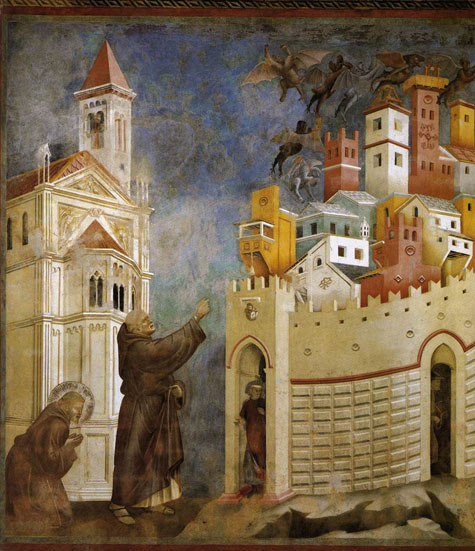
However, this is more evidence also of Pope Francis' likeness, very intentional, with his namesake St. Francis. St. Francis was fascinated with devils. One famous story has him in Arezzo (where I am today!) expelling or should I say exorcising some devils from the entire city. Here is how Giotto paints it.
I hope he got them all out!

Dante recognizes St. Francis' belligerence towards devils in our world. Indeed, one of the most well-known passages from Inferno, has St. Francis LOSING OUT to a devil. In Canto XXVII of Inferno, the damned shade of Guido of Montefeltro relates how he, having sinned greatly in life as a crooked political consultant (boy, does he have lots of company now), tried to make up for his life of deception by joining the Franciscan order at the end of his life. Tricked by the sitting Pope (Boniface VIII) into continuing his evil ways even after becoming a Franciscan monk, Guido finds a surprise when he dies. To quote one of my favorite undergraduate professors who, when playing a recording of Hildegard of Bingen, preluded a change in vocal tone with these words...  "Here comes the Devil!"

Francesco venne poi, com' io fu' morto,27.112Then Francis came, as soon as I was dead,
per me; ma un d'i neri cherubinifor me; but one of the black cherubim
li disse: 'Non portar; non mi far torto.told him: 'Don't bear him off; do not cheat me.
Venir se ne dee giù tra ' miei meschini27.115He must come down among my menials;
perché diede 'l consiglio frodolente,the counsel that he gave was fraudulent;
dal quale in qua stato li sono a' crini;since then, I've kept close track, to snatch his scalp;
ch'assolver non si può chi non si pente,27.118one can't absolve a man who's not repented,
né pentere e volere insieme puossiand no one can repent and will at once;
per la contradizion che nol consente.'the law of contradiction won't allow it.'
Oh me dolente! come mi riscossi27.121O miserable me, for how I started
quando mi prese dicendomi: 'Forsewhen he took hold of me and said: 'Perhaps
tu non pensavi ch'io löico fossi!'you did not think that I was a logician!'
Minòs mi portò; e quelli attorse27.124He carried me to Minos; and that monster
otto volte la coda al dosso duro;twisted his tail eight times around his hide
e poi che per gran rabbia la si morse,and then, when he had bit it in great anger,
disse: 'Questi è d'i rei del foco furo';27.127announced: 'This one is for the thieving fire';
per ch'io là dove vedi son perduto,for which-and where, you see-I now am lost,
e sì vestito, andando, mi rancuro."and in this garb I move in bitterness."


So Francis is fooled, and the devil outwits him. Or at least that is what the soul of Guido wants us to believe. As I tell my students when I lecture on this canto, be careful in reading the words of Dante's sinners: liars in life continue to lie in hell. Do we really think St. Francis would have gotten this wrong?


So, St (Pope) Francis and the devil. Yet another moment when medieval meets modern in today's Italy.

Friday, May 17, 2013

The Descent (ooh, That Smell) into Inferno

The Descent (ooh, That Smell) into Inferno.


Holding my nose, gag reflex suppressed, I have downloaded (on the iPad; the physical book I will not admit to my library) Dan Brown's Inferno. I will begin reading it when I have nothing else to do, which, unfortunately, might be very soon. I am currently in a "transition" space between my old MacBook and a new MacBook, Victor having mistaken the former for a flower, dousing it with a nice cup of water. So, my new MacBook is shinny and new, but does not have Microsoft Office installed, so little more than a toy. 

In any case, my Summer and my lack of computer to work on my real work has given me the time to read Dan Brown's Inferno. But for now, the rain has stopped and I am going for a bike ride!

Those of you that have read the book or are reading it now, please offer your comments, critiques and/or praise via the comment button on this blog. No spoilers!

Friday, May 10, 2013

Graduation Day: Virgil's Valedictory

Graduation Day: Virgil's Valedictory 


It is a happy time on college campuses as graduation season gets into full swing. Many students are finishing 4 or 5 years (or maybe more, I am not judging) of study, writing, and other activities at university. With better job prospects seemingly on the horizon, Spring's green seems a little brighter this year than in the recent past. Underclassmen and faculty also welcome the arrival of the long Summer break, with visions of travel, relaxation, fulfilled research goals, and other pleasures.

Here in Arezzo we say goodbye to yet another great group of OU students who have spent the past 4 months studying and living in Italy. While they are certainly happy to return home and see friends and family, I notice that as their days in Italy draw to a close, many of them are already scheming to get back to Italy soon. I share their bittersweet sentiments; for me, this has been my life's occupation. 

Let's recall the great Valedictory speech that Virgil delivers to Dante as he exits Purgatory in Canto XXVII. Graduations speeches today are almost always conventional, ritualistic. Reading Virgil's words reminds us how OLD this ritual is and how enduring the need for words of wisdom at this time.

e disse: "Il temporal foco e l'etterno27.127“My son, you’ve seen the temporary fire
veduto hai, figlio; e se' venuto in parteand the eternal fire; you have reached
dov' io per me più oltre non discerno.the place past which my powers cannot see.
Tratto t'ho qui con ingegno e con arte;27.130I’ve brought you here through intellect and art;
lo tuo piacere omai prendi per duce;from now on, let your pleasure be your guide;
fuor se' de l'erte vie, fuor se' de l'arte.you’re past the steep and past the narrow paths.
Vedi lo sol che 'n fronte ti riluce;27.133Look at the sun that shines upon your brow;
vedi l'erbette, i fiori e li arbuscellilook at the grasses, flowers, and the shrubs
che qui la terra sol da sé produce.born here, spontaneously, of the earth.
Mentre che vegnan lieti li occhi belli27.136Among them, you can rest or walk until
che, lagrimando, a te venir mi fenno,the coming of the glad and lovely eyes—
seder ti puoi e puoi andar tra elli.those eyes that, weeping, sent me to your side.
Non aspettar mio dir più né mio cenno;27.139Await no further word or sign from me:
libero, dritto e sano è tuo arbitrio,your will is free, erect, and whole—to act
e fallo fora non fare a suo senno:against that will would be to err: therefore
per ch'io te sovra te corono e mitrio."27.142I crown and miter you over yourself.”
Virgil enjoins Dante to let pleasure be his guide. Take time to "stop and smell the flowers" as our cliche  has it. I know most of our graduating seniors want to get off to a running start in their careers, but Virgil's words merit some attention. Perhaps not right now, but sooner or later, the present will be a memory, growing ever distant. Attend to pleasure, delight, and dalliance, as they will become the background to the portrait you paint of your own past. 

Dante has passed a intellectual and ethical test in exiting Inferno and climbing Mt. Purgatory. Graduating seniors have also passed tests, both intellectual and ethical, in graduating from college, hopefully less harsh. Dante has perfected himself intellectually and ethically and awaits only the final rituals before his ascent to Paradiso. Seniors are beginning new tests of intellect and of character and have a long way before their own ascent to the the "Great old folks home in the sky." You will make mistakes, as Dante does as he meets his new guide and, in a moment of fear, looks back for Virgil, only to find him absent.  But, also just as Dante does, admit your errs, ask for advice and wisdom, and keep moving up!

Wednesday, May 8, 2013

Giulio Andreotti faces Minos- The Tale of the Tail

Giulio Andreotti faces Minos- The Tale of the Tail

One of Italy's most powerful, loved, hated, enigmatic politicians, Giulio Andreotti, has died. Even though I follow Italian politics, medieval, Renaissance, and modern, pretty closely, the case of Andreotti is beyond my reckoning. Read the New York Times obit and just note the either/or rhetoric that they use to describe his incredible (in the sense of unbelievable to our sense of politics) political career.

What strikes me about Andreotti is how long he held power-- politically active from the 1940s until the 1990s and even beyond into the 21st century. He maintained power without scruples, making unfathomable deals with political enemies (as the leader of the Christian Democrats he unified with the Italian Communists), terrorists, foreign governments (CIA), the mafia, and many Popes. The only thing it seems that mattered to Giulio Andreotti was the Giulio Andreotti remain in power because, it seems, he knows what is best for Italy. 


The movie "Il Divo" is hard to understand for an American audience, it is such "Inside baseball" of the Italian post-war political scene, but I recommend it for any interested in seeing what a mess Italian politics were and why it is so hard for Italians to move ahead today OR to trust their politicians.


Much in the Italian press on his death has focused on the secrets that Andreotti will take to the grave. But, Minos, as God's judge in Inferno knows all. How many times will Minos' tail wrap itself around the infernal judge? Where does Andreotti go in Dante's Hell? Or, does he belong in Purgatorio? Can he be redeemed? I invite comments/suggestions from my Italian readers.


Tuesday, April 23, 2013

Bersani the snake: Peculato

Bersani the snake: Peculato


25.97
Let Ovid now be silent, where he tells


of Cadmus, Arethusa; if his verse


has made of one a serpent, one a fountain,


25.100
I do not envy him; he never did


transmute two natures, face to face, so that


both forms were ready to exchange their matter.


Oh, what a week it has been in Italian politics! This rump of a parliament has responded to the loud cry for change that the electorate delivered in February by doing something so new it has never happened before...re-elected Giorgio Napoletano their 85 year old President to a second 7 year term! This is change!?!?

The sense of frustration with politics as usually in Italy-- the caste system of the politicians (left and right), the inability of politicians to find a reasonable solution to any of Italy's myriad problems, the massive salaries and benefits of their bloated parliament-- has reached a new level this weekend. After months of mud slinging, posturing, and wars of words in the press (all the groups have done their fair share, including Sig. B. Grillo), Italy's two great enemies, the center-left PD (Partito Democratico) and the center-right PDL (Popolo dell Libertà) have joined forces to re-elect an ancient man as President of Italy. An example of blatant and disgusting politics of self-conservation.

It was unfathomable that the party of former communists, socialists, and Green party supporters lead by Pier Luigi Bersani would unite with the party of Silvio Berlusconi and the Lega Nord separatists. But the advent and popularity of the Movimento Cinque Stelle and their unwillingness to set aside its scruples and "fare l'inciucio (underhand schemes), has brought Left and Right together to create a new type of government in Italy. They have created a monster.


this political cartoon offers the best definition I could find for the Italian word "inciucio"


I have already put Berlusconi in Hell, so I can't move him (Divine Justice does not make changes!), but Bersani and his PD conspirators have yet to receive Minos' bestial judgment!

The bestial union of two opposites into a new monstrosity recalls most vividly Dante's description of the transformations of the thieves in Inf. XXIV and Inf. XXV. Dante describes three different types of transformations, but the one the fits these the best describes the sin of Peculato, or theft of a public good.

These sinners are attacked by a reptile and then merge with that reptile to form a new monstrous serpentine beast. Bersani here takes a majority of the blame for the PD's collective sin, and he has merged with the slimy reptile Berlusconi (leader of the PDL) to form this new hideous government.
Why is this a monstrosity and not a positive moment of bi-partisanship? The motive for this unnatural union is the preservation of the two-party system, the caste system, that benefits both parties while not serving Italy's interests or respecting the clear call of the vox populi.

The crime of Peculato is the specifically theft of a public good. What has public good has the PD and PDL stolen here?  Democracy itself. Nobody can deny Italians voted for change and specifically for change in the politics of the parties (and their massive government funding), but they got an unprecedented "more of the same" outcome. PD and PDL ignored the voters will; even their own voters who are now protesting the idea of unifying with their enemies. PD's self-immolation is the only consolation for voters feeling stunned and dismayed at this new low.

Italians are mad and disillusioned, and I understand why better now than ever. The best we can hope is that the young Italians who voted M5S or PD keep their heads up, as they did this weekend with their peaceful march in Rome.


We can hope that they continue to make their voices heard democratically and refuse invitations to violence or despair. After all, an 86 year old president is like a 76 year old Pope with one lung: a temporary solution.